
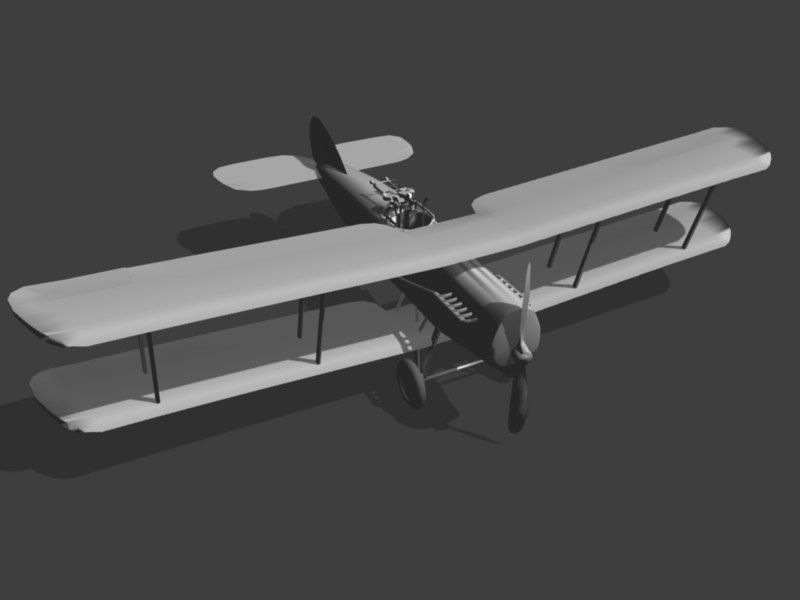


Bristol F2B 3D-Modell
0


Royalty Free LicenseNur redaktionell
Einfache Rückgabe
Best-Preis-Garantie
Funktioniert aus dem Kasten heraus
0
Besuche

Eingereicht von
pbratt
Spezifikationen
- Geometriepolygonal
- Polygone27,579
- Scheitelpunkte18,831
- TexturenYes
- ManipuliertenNo
- AnimiertNo
- Bereit zum Drucken in 3DNo
- Spielbereit (low poly)No
- UV-kartiertYes
- Unverpackte UVsnone
Beschreibung
The Bristol F2b Fighter was one of the truly great British fighters of the Great War and yet it had one of the most disastrous debuts of any WW1 fighter aircraft. On 5th April 1917 six Bristol F2a's led by Capt. Leefe Robinson VC were decimated in combat with five Albatros DIII's led by Baron Manfred Von Richthofen. Further heavy casualties were suffered in the days that followed. It soon became apparent that the big fighter was being flown incorrectly, that is to say as a two seater relying on the rear firing Lewis gun for offence as well as defence.
Pilots at squadron level however began to take matters into their own hands. It was realised that the Bristol Fighter was as fast, or faster than the German scouts and for an aircraft of it's size, very agile as well as being extremely rugged. Most importantly it had a forward firing gun mounted under the engine cowling firing through the propellor and when flown like a single seater with the added bonus of a rear firing gun to cover the tail, the Bristol Fighter came into it's own. The definitive Bristol F2b powered by the Rolls Royce Falcon of 275 HP entered service during June 1917 and was to excel as a superb general purpose fighter. The Brisfit or Biff as it was known to it's pilots was so feared by the German High command that German pilots were ordered never to engage the fearsome two seater except under conditions of overwhelming numerical superiority.
The leading exponents of the Bristol Fighter were the Canadian Lt. Andrew McKeever, and his observer Sergeant L. F. Powell who destroyed thirty enemy aircraft. On one occasion McKeever and Powell on a solitary patrol encountered two German reconnaissance machines escorted by seven Albatross single seaters. In the ensuing combat both the reconnaissance machines were destroyed along with two of the escort.
By mid 1918 fifteen squadron were equipped with the Bristol F2b performing a multitude of tasks and was universally popular with its crew. After WW1 the Bristol fighter remained in RAF service until the 1930's.
Dec 25, 2019
Datum hinzugefügt
Mar 17, 2023
letztes Update
Bewertungen
Es liegen noch keine Bewertungen für dieses Produkt vor.
Warum nicht der erste sein, der das Eis bricht?