










Amylose 3D model
0



Royalty Free LisansTüm genişletilmiş kullanımlar
Basit iadeler
En iyi fiyat garantisi
Kutunun dışında çalışır
50
ziyaret

Tarafından gönderilmiştir
MichaelTaylor3D
Özellikler
- Geometripolygonal
- Çokgenler127,860
- Tepe Noktaları66,466
- DokularYes
- hileliNo
- canlandırılmışNo
- 3D Yazdırılabilir HazırNo
- Oyuna Hazır (düşük poli)No
- UV HaritalıNo
- Sarılmamış UV'lerunknown
Açıklama
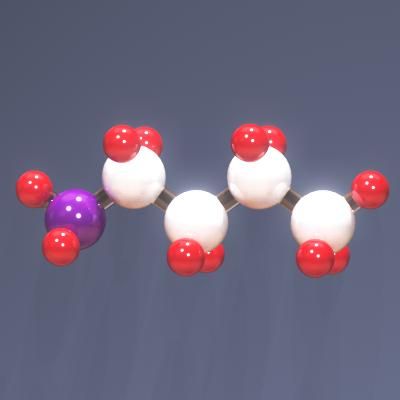
This is a ready to go out-of-box molecule, It is 100% accurate to the real chemical structure, Real scientific data was used as a reference to the construction of this model.
Amylose is a linear polymer of glucose.
Amylose is one of the two components of starch, the other being amylopectin. Amylose is soluble in water.
The carbon atoms on glucose are numbered, starting at the aldehyde (C=O) carbon. In amylose, the 1-carbon on one glucose molecule is linked to the 4-carbon on the next glucose molecule (?(1?4) bonds). It can be made of several thousand glucose units.
The ?(1?4) bonds promote the formation of a helix structure. The structural formula of amylose is pictured at right. The number of repeated glucose subunits (n) is usually in the range of 300 to 3000, but can be many thousands. There are six glucose monomers per helix.
Amylose starch is less readily digested than amylopectin; however, it takes up less space so is preferred for storage in plants. It makes-up about 30% of the stored starch in plants, though the specific percentage varies by species. The digestive enzyme amylase breaks down the starch molecule into maltotriose and maltose.
Iodine molecules fit neatly inside the helical structure of amylose, binding with the starch polymer that absorbs certain known wavelengths of light. Hence, a common test for starch is to mix it with a small amount of yellow iodine solution. In the presence of amylose, a blue-black color will be observed. The intensity of the color can be tested with a colorimeter, using a red filter to discern the concentration of starch present in the solution.
High-amylose varieties of rice have a much lower glycemic load, which could be beneficial for diabetics.
Sep 24, 2019
Ekleme Tarihi
Jan 24, 2022
son Güncelleme
Yorumlar
Bu ürün için henüz hiç yorum yapılmamış.
Neden buzu kıran ilk kişi değilsin?
